Central Bank Holds Lending Rate as Kenya Monitors Inflation
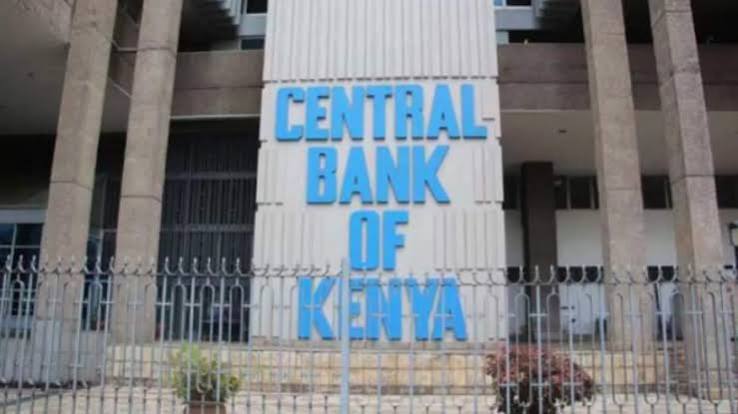
The Central Bank of Kenya (CBK) has maintained its benchmark lending rate, signalling a cautious approach to monetary policy as the country continues to monitor inflation and broader economic conditions.
In a report published by Reuters on 7 October, the central bank said it expected inflation to remain within its target range in the short term, despite an increase over the preceding three months.
Photo: Courtesy
The decision to retain the benchmark rate reflects the bank’s assessment of current economic conditions and the need to balance price stability with economic activity.
Interest-rate decisions have important implications for households, businesses and financial institutions.
For borrowers, the benchmark rate influences the wider lending environment, although the effect on individual loan rates depends on the type of loan, the lender and other market conditions.
Businesses also monitor monetary policy because borrowing costs can influence investment decisions, expansion plans and working capital.
Meanwhile, consumers remain concerned about the cost of living, including food, transport, electricity and other essential expenses.
The central bank’s decision will therefore be closely watched by businesses, investors and households seeking signs of how economic conditions may develop in the coming months.
However, maintaining the rate does not guarantee that commercial banks will immediately reduce their lending rates or that consumer prices will fall.
Eliud Kipchoge Makes History with Melbourne Marathon Victory
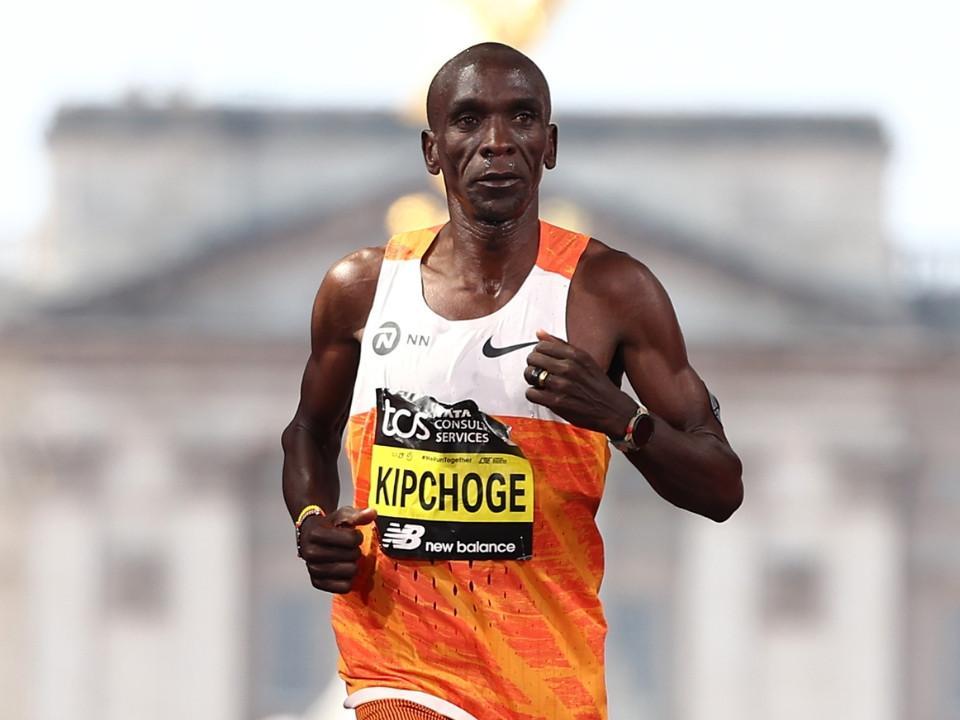
Kenyan marathon legend Eliud Kipchoge has delivered another remarkable performance, winning the Melbourne Marathon in Australia in a time of 2:09:10.
The victory adds another achievement to the career of one of the world’s most celebrated long-distance runners.
Photo: Courtesy
Kipchoge’s performance also set a new course record, further strengthening Kenya’s reputation as a powerhouse in international distance running.
Over the years, the athlete has established himself as one of the most influential figures in marathon racing. His achievements have inspired runners across Kenya and internationally, while his commitment to discipline and endurance has made him a prominent ambassador for Kenyan athletics.
The Melbourne victory is also reported to be his 17th career marathon win.
Kipchoge’s continued participation in major international races demonstrates his enduring presence in the sport and his ability to attract attention to Kenyan athletics.
His achievement comes as Kenyan athletes continue to represent the country in international competitions, reinforcing the importance of investment in training, coaching and sports development.
Kenya Reports No New Ebola Cases as Health Authorities Intensify Surveillance
Kenya has reported no new Ebola cases following the testing of 293 individuals, offering encouraging news after the country confirmed its first imported case of Bundibugyo Ebola virus disease earlier this month.
According to a report published by Reuters on Sunday, 11 October, the latest testing results indicate that no additional infections have been detected following the death of a Kenyan citizen who had travelled from the Democratic Republic of Congo (DRC).
The patient, who had reportedly been living in the DRC, travelled through Uganda before arriving in Nairobi. He subsequently tested positive for the virus and died on 5 October.
The case prompted the government to strengthen disease surveillance, investigate potential exposure and improve screening procedures at points of entry.
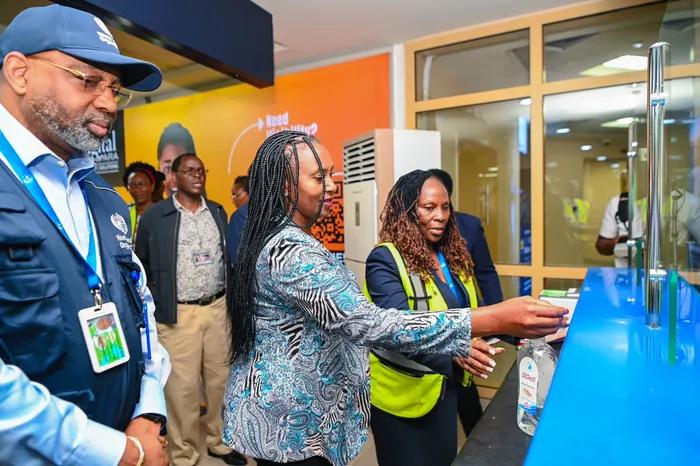
Photo: courtesy
Kenya’s Ministry of Health has also been working to trace individuals who may have come into contact with the patient. Authorities have emphasised the importance of monitoring contacts and identifying suspected infections promptly.
The absence of additional cases is encouraging, but health officials must continue surveillance to reduce the risk of further transmission.
The situation also highlights the importance of regional cooperation, particularly between Kenya, Uganda and the DRC, in responding to infectious diseases that cross national borders.
Two police officers, including a senior police commander, have been killed after their vehicle struck a suspected Improvised Explosive Device (IED) along the Saretho–Dadaab road in Garissa County on Friday morning.
The incident occurred at approximately 6:00 a.m. when a Toyota Land Cruiser attached to Hagadera Police Station ran over the suspected explosive device along the main supply route, killing the Hagadera Sub-County Police Commander and his driver at the scene.
According to reports by Kenyan media, the explosion extensively damaged the vehicle, prompting a security response in the area as authorities began investigating the incident.
Garissa County Police Commander Samson Chelugo confirmed the deaths, while additional security personnel were dispatched to the scene to investigate the circumstances surrounding the blast and pursue those responsible.
Preliminary reports suggest that the incident could be linked to militant activity in the region, with suspected Al-Shabaab militants being mentioned as possible perpetrators. However, no verified claim of responsibility had been reported at the time of publication.
Investigators are working to establish how the explosive device was planted along the road and identify those responsible for the attack. Security operations have also been intensified in the area following the incident.
The attack has renewed concerns about the safety of roads used by security officers and other motorists in northeastern Kenya, particularly in areas near the Kenya–Somalia border.
Garissa and neighbouring counties have experienced previous incidents involving roadside explosives, which have targeted security personnel and disrupted movement along key transport routes.
The Saretho–Dadaab road is an important route for transportation and security operations in the region. The latest incident highlights the continuing challenges facing security agencies as they work to protect personnel and communities.
Investigations into Friday’s explosion remain ongoing, with authorities expected to provide further information as more details become available.
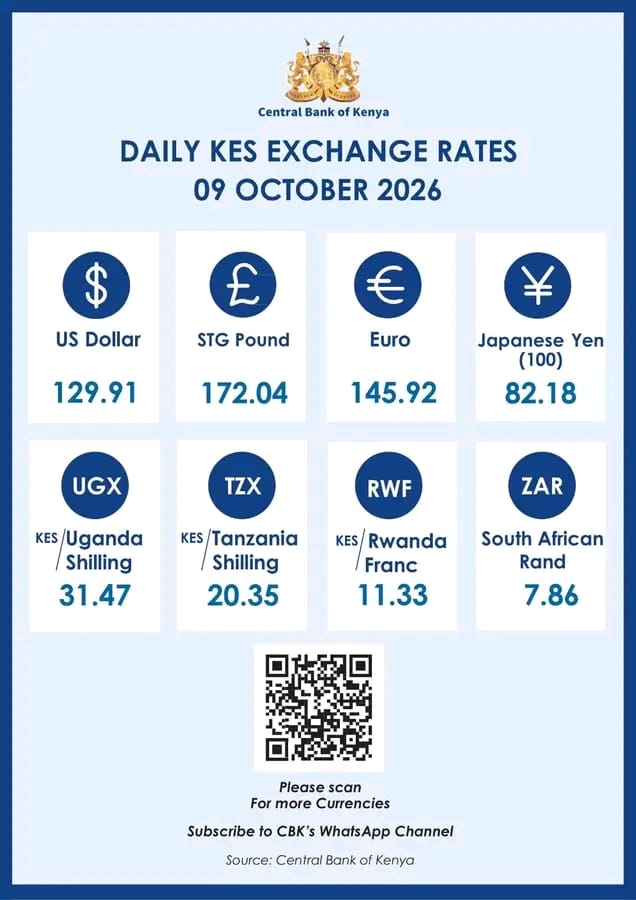
The Central Bank of Kenya (CBK) has released its daily exchange rates for Friday, October 9, 2026, showing the value of the Kenyan shilling against major international and regional currencies.
According to the CBK rates, the US dollar is trading at KSh 129.91, while the British pound stands at KSh 172.04. The euro is exchanging at KSh 145.92.
Photo: Central Bank of Kenya
The Japanese yen, quoted in units of 100, is trading at KSh 82.18, according to the published figures.
Regionally, the Kenyan shilling is exchanging at 31.47 Ugandan shillings, 20.35 Tanzanian shillings and 11.33 Rwandan francs. The South African rand is trading at KSh 7.86.
The exchange rates provide a daily reference for individuals, businesses and financial institutions involved in foreign currency transactions, international trade and travel.
The US dollar, British pound and euro are particularly important for international payments, imports, exports and other cross-border financial transactions.
The CBK has encouraged members of the public to access additional currency rates through its official communication channels, including its WhatsApp channel.
Source: Central Bank of Kenya (CBK), Daily KES Exchange Rates, October 9, 2026.
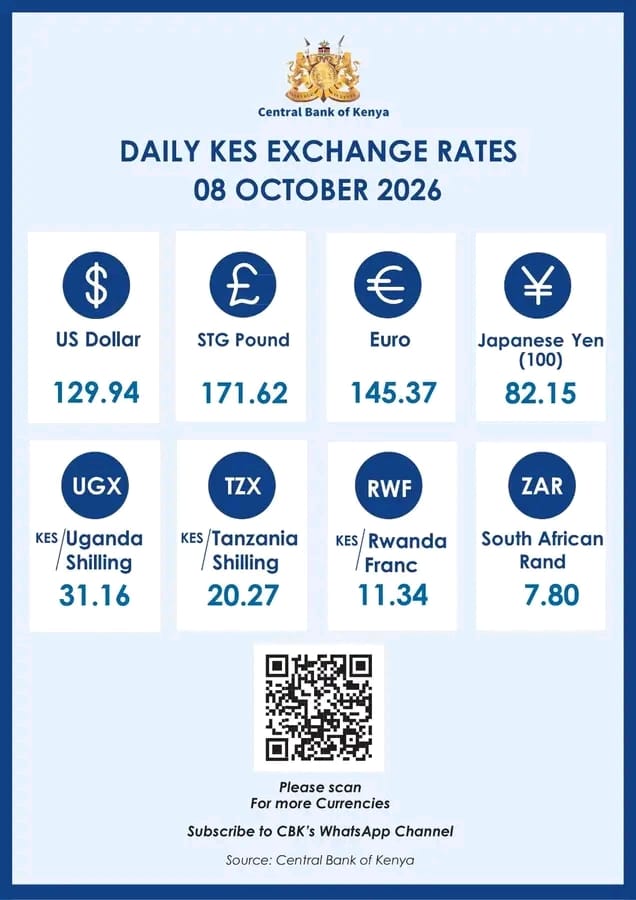
The Kenyan shilling is trading at KSh129.94 against the US dollar, according to the latest daily exchange rates published by the Central Bank of Kenya (CBK) on Thursday, October 8, 2026.
The CBK’s daily rate sheet shows the British pound trading at KSh171.62, while the euro is quoted at KSh145.37.The Japanese yen, quoted for 100 yen, stands at KSh82.15.Among regional and African currencies, the Uganda shilling is trading at KSh31.16, while the Tanzanian shilling stands at KSh20.27. The Rwandan franc is quoted at KSh11.34, while the South African rand is trading at KSh7.80.
image source: Central Bank of Kenya
CBK exchange rates for October 8, 2026CurrencyExchange rate in KESUS Dollar (USD)129.94British Pound (GBP)171.62Euro (EUR)145.37Japanese Yen (100 JPY)82.15Uganda Shilling (UGX)31.16Tanzania Shilling (TZS)20.27Rwanda Franc (RWF)11.34South African Rand (ZAR)7.80
The rates provide a reference for businesses, travellers, importers, exporters and financial institutions dealing in foreign currencies. Actual commercial bank and forex-bureau rates may differ depending on buying and selling spreads and other charges.
The figures are contained in the CBK’s Daily KES Exchange Rates for October 8, 2026.
False reports claiming that Siaya Senator and ODM party leader Oburu Oginga has died have circulated widely on social media, prompting his office, family members and political colleagues to issue statements disputing the claims.
The rumours emerged on Tuesday, October 6, amid existing public concern over the veteran politician’s health. Oburu’s secretariat subsequently said the senator was alive, safe and in good spirits, while confirming that he had been advised by doctors to rest and limit strenuous engagements.
The reports gained traction after social-media posts claimed that the 83-year-old politician had died. His office attributed the latest claims to online misinformation and urged members of the public and the media to rely on official communication rather than unverified social-media posts.
The latest rumours came against the backdrop of genuine concerns about Oburu’s health.
The senator had recently sought medical attention, with ODM communications officials saying he was resting on medical advice. His office said he was continuing to observe doctors’ instructions to reduce heavy physical activity while remaining engaged with party and national affairs.
ODM national chairperson Gladys Wanga also said she had visited Oburu and found him in good spirits. On Wednesday, Nairobi Senator Edwin Sifuna referred to the reports in the Senate, expressing concern about misinformation surrounding his colleague’s health.
The issue remained in the public spotlight after Oburu was unable to attend the handover and dedication ceremony for the mausoleum of his late brother, former Prime Minister Raila Odinga, at Kang’o ka Jaramogi in Bondo.
Raila’s widow, Ida Odinga, apologised for Oburu’s absence and said he was unwell, while asking Kenyans to continue praying for his recovery. TThe Star
The latest episode is not the first time false reports of Oburu’s death have circulated online.
In September, fact-checking organisation Africa Check investigated social-media posts claiming that Oburu had died. Some of the posts used videos purporting to show President William Ruto announcing his death.
Africa Check found that the videos had been misleadingly edited or taken out of context. In one case, footage of President Ruto referring to the late Raila Odinga was edited in a way that made it appear as though he was announcing Oburu’s death. Another video showing Ruto and First Lady Rachel Ruto paying respects to a body was actually footage from the public viewing of Raila Odinga’s body following his death in October 2025.
Africa Check reported at the time that the false claims had attracted millions of views across social-media platforms.
The recurrence of the rumours has renewed concerns about the speed at which unverified information about prominent public figures can spread online.
Oburu’s office has urged the public to disregard what it described as sensational and unfounded reports and to seek confirmation through official channels. The office also said it was consulting ODM leadership over possible legal action concerning the circulation of the claims.
For now, there is no credible evidence that Oburu Oginga has died. Public statements from his office and political colleagues instead indicate that he is alive and recovering while observing medical advice. His exact medical condition has not been publicly disclosed.
The episode highlights the difficulty of separating genuine health updates from false information online, particularly when rumours involve prominent political figures and are accompanied by old, edited or misleading video footage.
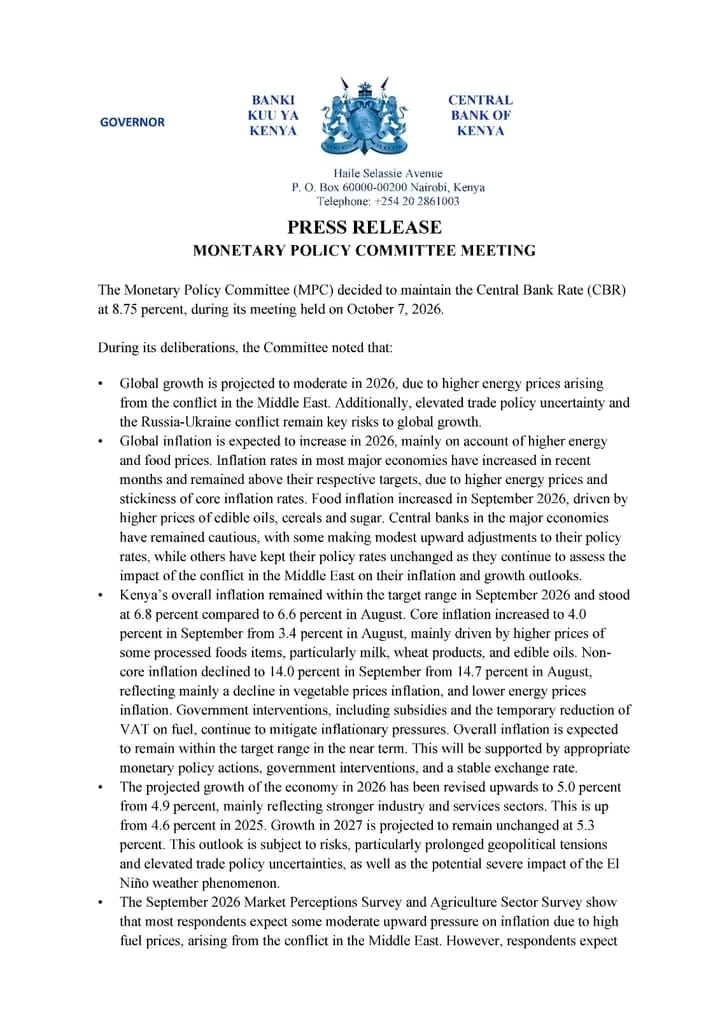
The Central Bank of Kenya (CBK) has retained its benchmark Central Bank Rate (CBR) at 8.75 percent, citing the need to keep inflation expectations anchored while supporting stability in the foreign exchange market.
The decision was reached by the Monetary Policy Committee (MPC) during its meeting on October 7, 2026, as the committee assessed developments in inflation, economic growth, the exchange rate and global economic conditions.
The MPC noted that Kenya’s overall inflation rose to 6.8 percent in September, up from 6.6 percent in August, but remained within the government’s target range. The increase was largely attributed to higher prices of food and energy.
Core inflation also increased to 4.0 percent in September from 3.4 percent in August, driven mainly by higher prices of processed food products, including milk, wheat products and edible oils. However, non-core inflation declined to 14.0 percent from 14.7 percent, reflecting lower vegetable prices, despite continued pressure from fuel and energy costs.
The committee said government interventions, including subsidies and the temporary reduction of VAT on fuel, had helped ease some inflationary pressures.
Photo: Central Bank of Kenya
The CBK has revised upwards its projection for Kenya’s economic growth in 2026 to 5.0 percent, from an earlier estimate of 4.9 percent.
The stronger outlook is mainly supported by improved performance in the industry and services sectors. Economic growth is projected to remain strong in 2027 at 5.3 percent.
However, the CBK warned that the outlook remains exposed to risks, particularly prolonged geopolitical tensions, uncertainty over global trade policies and the potential effects of the El Niño weather phenomenon.
The committee said surveys conducted in September showed continued optimism among businesses about economic activity over the next 12 months. Respondents attributed the optimism to macroeconomic stability, increased government infrastructure spending, digital innovation and improved private-sector credit growth.
Businesses, however, remained concerned about elevated energy costs linked to the conflict in the Middle East and possible disruptions from El Niño-related weather conditions.
Image: Central Bank of Kenya
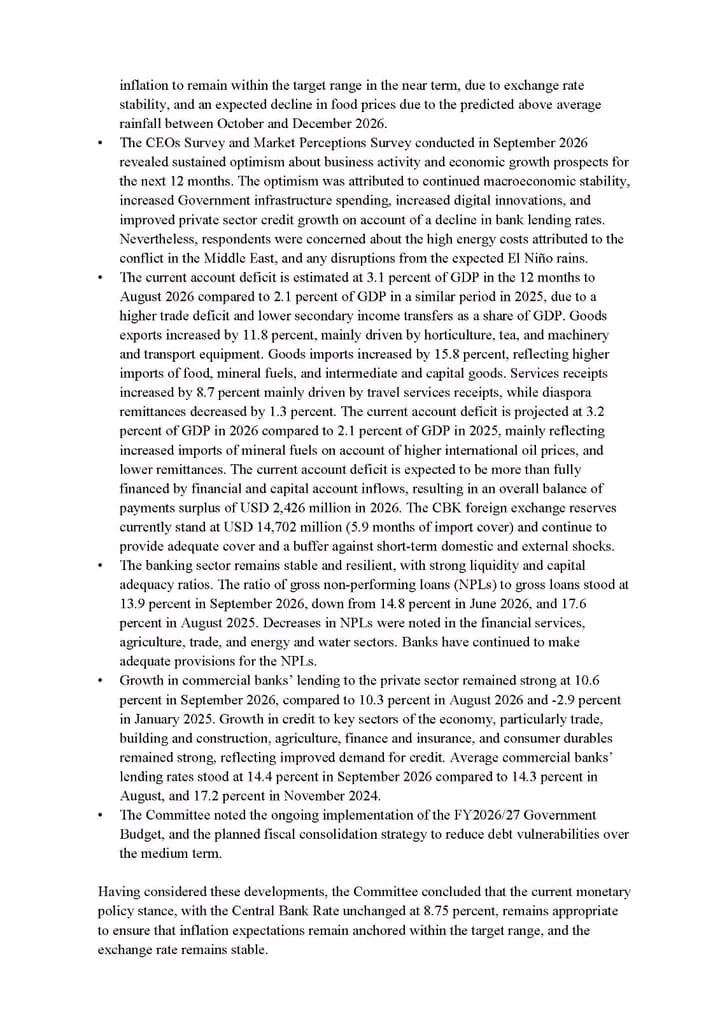
The country’s current account deficit widened to an estimated 3.1 percent of GDP in the 12 months to August 2026, compared with 2.1 percent during a similar period in 2025.
The CBK attributed the widening deficit largely to a higher trade deficit and lower secondary income transfers as a share of GDP.
Goods exports increased by 11.8 percent, supported mainly by horticulture, tea, machinery and transport equipment. At the same time, goods imports grew by 15.8 percent, driven by higher imports of food, mineral fuels and intermediate and capital goods.
Services receipts rose by 8.7 percent, mainly on the back of increased travel services receipts, while diaspora remittances declined by 1.3 percent.
The CBK expects the current account deficit to widen further to about 3.2 percent of GDP in 2026, mainly because of increased mineral-fuel imports following higher international oil prices and lower remittance inflows.
Image: Central Bank of Kenya
Despite the external pressures, Kenya’s foreign exchange reserves remained at a comfortable level.
The CBK said official reserves stood at approximately US$14.702 billion, equivalent to 5.9 months of import cover.
The reserves, the committee said, continue to provide an adequate buffer against short-term domestic and external economic shocks.
The CBK also noted that the current account deficit is expected to be fully financed by financial and capital account inflows, resulting in an overall balance of payments surplus of about US$2.426 billion in 2026.
The banking sector continued to record strong liquidity and capital adequacy, although the ratio of gross non-performing loans (NPLs) to gross loans stood at 13.9 percent in September 2026.
This was an improvement from 14.8 percent in June 2026 and 17.6 percent in August 2025.
The CBK said reductions in non-performing loans were recorded in the financial services, agriculture, trade, and energy and water sectors, while banks continued to maintain adequate provisions against bad loans.
Commercial banks’ lending to the private sector also remained strong, with credit growth reaching 10.6 percent in September, compared with 10.3 percent in August and -2.9 percent in January 2025.
The growth was particularly evident in trade, building and construction, agriculture, finance and insurance, as well as consumer durables.
CBK maintains policy stance
The MPC also noted the ongoing implementation of the FY2026/27 Government Budget and the planned fiscal consolidation strategy aimed at reducing Kenya’s debt vulnerabilities over the medium term.
After considering the economic developments, the committee concluded that maintaining the CBR at 8.75 percent was appropriate.
The CBK said the current monetary policy stance would help ensure that inflation expectations remain anchored within the target range while supporting stability in the exchange rate.
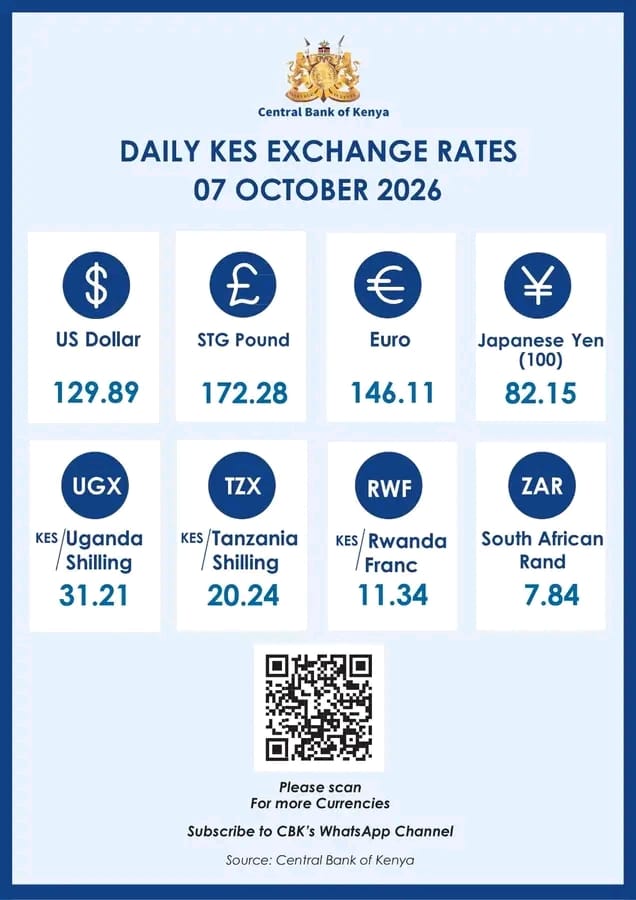
The Kenyan shilling remained relatively stable against major international currencies on Wednesday, according to the latest daily exchange rates published by the Central Bank of Kenya (CBK).
The CBK’s indicative rates put the US dollar at KSh129.89, up slightly from KSh129.79 recorded on October 6. The British pound was quoted at KSh172.28, while the euro stood at KSh146.11.
The Japanese yen was quoted at KSh82.15 for 100 yen, while regional currencies also recorded the following indicative values:
Ugandan shilling: KSh31.21 per 100 UGX
Tanzanian shilling: KSh20.24 per 100 TZS
Rwandan franc: KSh11.34 per 100 RWF
South African rand: KSh7.84
The latest figures indicate a modest movement in the shilling against the dollar. The dollar rate rose by about 10 cents from Tuesday’s KSh129.79, continuing a relatively narrow trading range in recent weeks. Historical data shows the CBK dollar mean rate was KSh129.71 on October 1 and KSh129.76 on October 5.
The CBK describes its published exchange rate as an indicative market rate calculated from weighted-average spot trades in the interbank foreign-exchange market. The rate is market-determined rather than fixed by the central bank, with supply and demand influencing the value of the shilling. Commercial banks and foreign-exchange bureaus may therefore offer rates that differ from the CBK’s indicative figure.
The exchange-rate update comes as the CBK continues to monitor domestic inflation and financial-market conditions. On Wednesday, the central bank kept its benchmark lending rate unchanged, saying inflation was expected to remain within its target range in the near term.
For Kenyan consumers and businesses, movements in the exchange rate remain important for the cost of imported goods, international travel, foreign-currency payments and remittances. Exporters and recipients of foreign currency, meanwhile, may benefit when major currencies strengthen against the shilling.
Source: Central Bank of Kenya daily exchange rates, October 7, 2026.
Fashion is not only about wearing expensive clothes. For men, looking sharp often comes down to understanding colour, fit and how different pieces work together.Unfortunately, many men put little thought into the colours they combine. A good shirt can easily lose its appeal when paired with trousers or shoes that clash with it. On the other hand, a simple outfit in the right colour combination can make a man look polished, confident and sophisticated.For men who want to improve their dressing without constantly buying new clothes, building a wardrobe around a few classic and versatile colours is a good place to start.
1. Navy blue — the ultimate classicNavy blue is one of the safest colours for a man’s wardrobe. It is sophisticated, versatile and suitable for both formal and casual occasions.A navy blazer can be worn with grey trousers, khaki chinos or even well-fitted jeans. A navy shirt can also work well with beige, white, grey or black trousers.Best combinations: Navy + white, navy + grey, navy + beige, navy + light blue.If a man is unsure about what to wear, navy is often a reliable choice.
image : Courtesy
2. White — simple but powerfulEvery man should own several good-quality white shirts and T-shirts.White works with almost everything and provides an excellent foundation for building an outfit. A crisp white shirt paired with navy or charcoal trousers can create a clean, professional appearance without being overly complicated.For a casual look, a white T-shirt can be paired with dark jeans, chinos or trousers.The secret with white clothing is cleanliness and fit. A poorly fitting or stained white shirt can have the opposite effect.
photo: courtesy
3. Black — elegant and timelessBlack is another essential colour because of its simplicity and versatility.A black shirt can be paired with grey, beige or dark trousers, while black trousers can work with white, blue, burgundy and other neutral-coloured shirts.However, men should be careful about wearing black from head to toe unless the occasion and style call for it. Breaking an all-black outfit with another colour can sometimes create a more balanced appearance.
image: courtesy
4. Grey — the underrated gentleman’s colourGrey is one of the easiest colours to incorporate into men’s fashion.From light grey to charcoal, the colour works particularly well for trousers, suits, sweaters and jackets.A charcoal suit with a white shirt is a timeless combination. Light-grey trousers can also be paired with navy, black, white or burgundy tops.Grey is particularly useful because it can soften stronger colours without creating a colour clash.
image : coutesy
5. Beige and khaki — perfect for smart-casual dressingBeige and khaki are excellent choices for men who want to look stylish without appearing overdressed.Khaki chinos, for example, can be paired with navy, white, light blue, burgundy or dark green shirts.A beige trouser combined with a navy shirt and brown shoes can create a sophisticated smart-casual appearance.These colours are especially useful for daytime events, casual Fridays, weekend outings and social occasions.6. Light blue — fresh and sophisticatedLight blue is particularly effective for shirts. It gives a softer appearance than dark blue while remaining professional.A light-blue shirt can be worn with navy trousers, charcoal trousers, beige chinos or dark jeans.For a man building his first proper wardrobe, a well-fitted light-blue shirt is a worthwhile investment.
image : courtesy
7. Burgundy — add colour without overdoing itNot every man’s wardrobe needs to be dominated by neutral colours. Burgundy can add personality while still looking mature.A burgundy shirt, sweater, tie or pocket square can work beautifully with navy, grey, black or beige.The important thing is moderation. Burgundy should generally be used as a feature colour rather than combined with several other strong colours at once.8. Olive and dark green — stylish and masculineOlive and dark green have become increasingly popular in men’s fashion because they provide colour without being too loud.Olive trousers can be paired with white, black, beige or navy tops. A dark-green shirt can work well with black, beige or grey trousers.These colours are particularly good for casual and smart-casual outfits.The golden rule: Don’t let your colours competeOne of the biggest mistakes men make is wearing too many strong colours at the same time.For example, combining a bright red shirt, yellow trousers, green shoes and a colourful jacket can make an outfit look confused rather than fashionable.A better approach is the three-colour rule: try to keep an outfit to around three colours, with at least one of them being a neutral colour such as white, black, navy, grey, beige or brown.
image : courtesy
For example:
Navy shirt + beige trousers + brown shoes = classy.
White shirt + charcoal trousers + black shoes = classic.
Light-blue shirt + navy trousers + brown shoes = sophisticated.
Burgundy shirt + black trousers + black shoes = sharp
.
Olive shirt + beige trousers + brown shoes = stylish and relaxed.
Don’t forget the shoesColour coordination does not stop with the shirt and trousers. Shoes can either complete an outfit or ruin it.
Brown shoes generally work particularly well with navy, beige, khaki and other lighter colours.
Black shoes are excellent with black, charcoal and many formal outfits.
For casual wear, clean white or neutral sneakers can work with jeans, chinos and other relaxed outfits.The belt should also generally complement the colour of the shoes, particularly in formal dressing.Fit matters more than the price tag a man does not necessarily need designer clothes to look fashionable.A reasonably priced shirt that fits properly, is clean and well-ironed can look considerably better than an expensive shirt that is too large, too tight or poorly matched with the rest of the outfit.Men should pay attention to shoulder fit, trouser length, shirt length and overall proportions.Build a wardrobe, don’t collect random clothesInstead of buying clothes simply because they look attractive on the rack, men should ask themselves whether the new item can be combined with what they already own.A practical wardrobe can start with:
White shirts and T-shirtsLight-blue shirtsNavy shirts or jacketsBlack trousersCharcoal or grey trousersBeige/khaki chinosDark jeansBrown and black shoesA navy blazerA few understated accessories
With these basics, a man can create numerous combinations without constantly buying new clothes.The bottom lineLooking classy is less about wearing many colours and more about knowing which colours work together.Men do not have to follow every fashion trend. By building their wardrobes around timeless colours such as navy, white, black, grey, beige, light blue, burgundy and olive, they can create outfits that look deliberate, clean and sophisticated.Ultimately, good fashion sends a simple message: you took time to present yourself well. And sometimes, the difference between looking ordinary and looking exceptionally sharp is not the price of the clothesit is simply choosing the right colours and wearing them with confidence.