By CYRUS MUNYAO
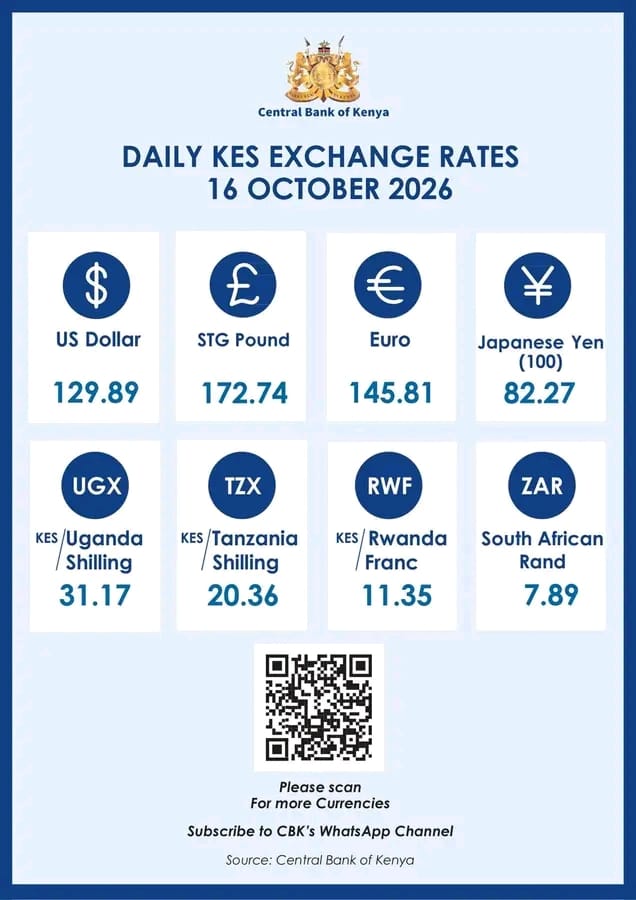
The Central Bank of Kenya (CBK) has published its daily indicative exchange rates for October 16, 2026, placing the US dollar at KSh129.89, the British pound at KSh172.74 and the euro at KSh145.81.
The rates provide a benchmark for businesses, importers, exporters, investors and individuals seeking to understand the value of the Kenyan shilling against major international currencies.
According to the CBK’s daily exchange-rate notice, the Japanese yen, quoted per 100 yen, stood at KSh82.27. Regional currencies were also listed, with the Uganda shilling trading at KSh31.17, the Tanzania shilling at KSh20.36 and the Rwanda franc at KSh11.35 against the Kenyan shilling. The South African rand was quoted at KSh7.89.
The publication comes as foreign-exchange movements remain an important consideration for businesses involved in international trade, particularly those importing fuel, machinery, electronics, pharmaceutical products and other goods priced in foreign currencies.
The US dollar rate is particularly important for Kenyan businesses because many international commodities and imports are priced in dollars.
At the indicative rate of KSh129.89 per dollar, an importer purchasing goods worth US$10,000 would require approximately KSh1,298,900 to cover the dollar amount, excluding bank charges, transaction fees, shipping costs, taxes and other expenses.
Changes in exchange rates can influence the cost of importing goods and, in some cases, the prices eventually paid by consumers.
A weaker shilling generally makes foreign-currency purchases more expensive in local-currency terms, while a stronger shilling can reduce the cost of imports, assuming other factors remain unchanged.
However, the actual rate available to an importer will depend on the commercial bank or foreign-exchange provider handling the transaction.
The British pound was quoted at KSh172.74, while the euro stood at KSh145.81.
Photo: Central Bank of Kenya
These rates are relevant to Kenyans paying tuition fees abroad, travelling internationally, receiving remittances or conducting business with partners in the United Kingdom and the euro area.
Businesses importing products from European markets may also use the published rates as a reference when estimating their foreign-currency obligations.
For exporters and recipients of foreign-currency payments, exchange-rate movements can affect the amount of Kenyan shillings received when overseas earnings are converted into local currency.
The CBK’s exchange-rate notice also listed currencies used by Kenya’s regional trading partners.
The Uganda shilling stood at KSh31.17, the Tanzania shilling at KSh20.36 and the Rwanda franc at KSh11.35.
These indicative rates provide a reference for businesses conducting cross-border trade within East Africa, including companies involved in agricultural products, manufactured goods, transport and wholesale distribution.
However, businesses should confirm the applicable transaction rates with their financial institutions before making payments or entering into foreign-exchange agreements.
The Central Bank of Kenya explains that its published exchange rates are calculated using the weighted average of registered spot transactions in the interbank foreign-exchange market.
The rates are intended to help the public gauge the value of the shilling. The CBK does not directly set the exchange rate, which is determined by market supply and demand.
Commercial banks and foreign-exchange bureaus may offer different buying and selling rates because of their operating costs, transaction sizes and margins.
Consequently, the published figures should be treated as indicative reference rates rather than guaranteed prices for individual transactions.
Businesses dealing in foreign currencies should continue monitoring exchange rates when preparing import budgets, pricing products and planning international payments.
Importers may need to account for possible currency movements when negotiating supplier contracts, while exporters should consider how changes in the shilling affect the local-currency value of their overseas earnings.
Individuals sending money abroad or receiving foreign remittances should also compare the rates and charges offered by different financial-service providers.
The latest CBK notice offers a daily reference point for these decisions, although determining whether the shilling has strengthened or weakened requires comparing the figures with previous rates.
As Kenya continues to engage in international and regional trade, foreign-exchange rates remain a key consideration for business costs, household transactions and financial planning.
Leave a Reply