CBK reports stronger foreign exchange reserves, rising gold prices and increased Treasury bond demand amid global economic uncertainty
Kenya’s foreign exchange reserves stood at $14.69 billion in the week ending October 15, 2026, providing a buffer against external economic shocks as the Kenyan shilling remained relatively stable against major international and regional currencies.
According to the Central Bank of Kenya’s (CBK) Weekly Bulletin dated October 16, the reserves were sufficient to cover approximately 5.9 months of imports, exceeding the statutory requirement of at least four months of import cover.
The reserves position highlights Kenya’s capacity to meet external payment obligations and support stability in the foreign exchange market amid persistent global economic uncertainty.
The CBK bulletin also reported increased demand for Treasury bonds, rising international oil prices and continued pressure on inflation, reflecting a mixed economic environment for businesses, investors and consumers.
Photo: Central Bank of Kenya
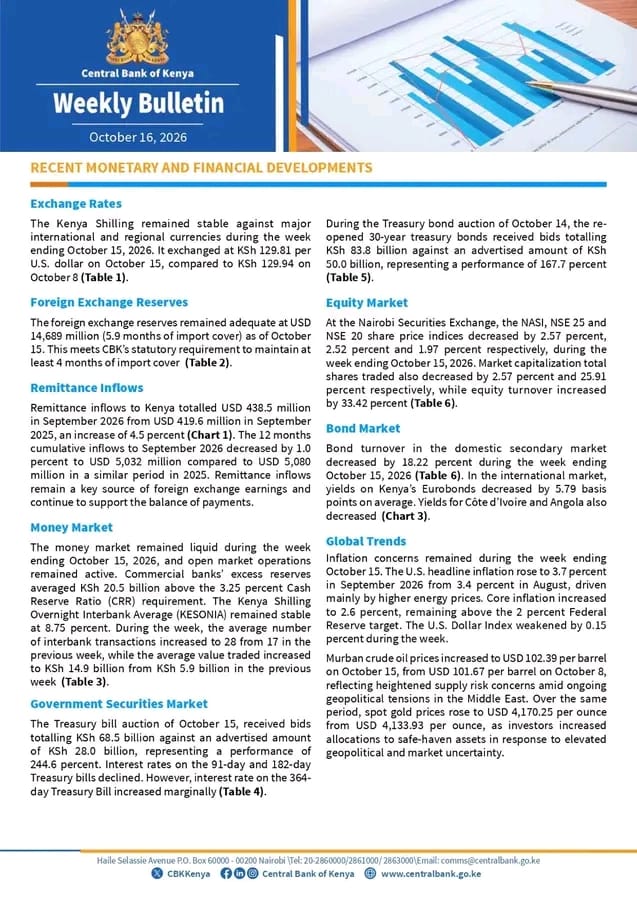
The Kenyan shilling traded at KSh129.81 against the US dollar on October 15, compared with KSh129.94 on October 8, indicating a slight appreciation over the period.
The relatively stable exchange rate provides some predictability for businesses that rely on imported raw materials, machinery, fuel and other goods priced in foreign currencies.
A stable shilling can help importers plan payments and manage operating costs. However, the actual impact on businesses also depends on global commodity prices, transport expenses and the exchange rates offered by commercial banks.
Foreign exchange stability is particularly important for Kenya because the country relies on imports for several essential products, including petroleum and industrial inputs.
The CBK’s foreign exchange reserves provide a cushion against external shocks and help strengthen confidence in the country’s ability to meet international payment obligations.
Kenya’s diaspora remittances increased to $438.5 million in September 2026, up from $419.6 million in August, representing a monthly increase of approximately 4.5 per cent.
The bulletin indicated that cumulative remittance inflows for the 12 months to September 2026 declined by 1.0 per cent to $5.032 billion, compared with $5.080 billion during the corresponding period previously.
Remittances remain an important source of foreign exchange for Kenya, supporting household consumption, education, housing and investment.
The funds also contribute to the country’s foreign currency supply, helping meet demand for dollars from importers and other businesses.
The monthly increase is encouraging for households receiving money from relatives abroad. However, the decline in cumulative inflows suggests that remittance performance remains an area to watch.
Investor appetite for government securities remained strong during the reporting period, with the October 14 Treasury bond auction receiving bids totalling KSh83.8 billion against an advertised amount of KSh50 billion.
This represented a performance rate of 167.7 per cent, indicating that bids substantially exceeded the amount the government had offered.
The strong demand suggests that investors remained willing to commit funds to government debt instruments.
Treasury bonds are used by the government to raise money for public expenditure and refinance existing obligations. They also provide investors with an avenue to earn interest over a specified period.
However, strong demand at an auction does not, by itself, establish that the government’s overall borrowing costs have declined. The final cost depends on the interest rates accepted and the characteristics of the securities issued.
Meanwhile, the CBK reported that the Treasury bill auction on October 15 attracted bids worth KSh68.5 billion against an advertised amount of KSh28 billion, representing a performance rate of 244.6 per cent.
Interest rates on Treasury bills generally declined during the week, although the rate on the 364-day Treasury bill increased marginally.
Trading at the Nairobi Securities Exchange (NSE) weakened during the week ending October 15, according to the CBK bulletin.
Photo: Courtesy

The Nairobi Securities Exchange 20 Share Index declined by 2.57 per cent, while the NASI and NSE 25 indices fell by 2.52 per cent and 1.97 per cent, respectively.
Market capitalisation declined by 2.57 per cent, while total shares traded fell by 2.57 per cent.
Despite the decline in market activity, equity turnover increased by 33.42 per cent, suggesting that the value of shares traded rose even as the total volume of shares exchanged fell.
The mixed performance highlights the importance of examining several indicators when assessing the stock market, rather than relying on a single measure.
For investors, movements in share prices, trading volumes and turnover can provide insights into market sentiment and the level of activity in listed companies.
International oil prices increased during the reporting week, adding to potential cost pressures for oil-importing economies such as Kenya.
The CBK bulletin reported that Murban crude oil rose to $102.39 per barrel on October 15, up from $101.67 on October 8.
Photo : Courtesy

The increase was attributed to supply risks and ongoing geopolitical tensions in the Middle East.
Higher oil prices can affect Kenya through increased import expenditure, higher fuel costs and rising transportation expenses. These pressures may subsequently influence the prices of goods and services.
For businesses, higher fuel prices can raise distribution and production costs, particularly in transport, manufacturing, agriculture and logistics.
If sustained, increases in international oil prices could also place additional pressure on the country’s import bill and inflation outlook.
Gold prices also rose during the week, reaching $4,170.25 per ounce on October 15, compared with $4,133.93 on October 8.
The bulletin attributed the increase to greater demand for safe-haven assets amid heightened geopolitical and market uncertainty.
Kenya’s headline inflation increased to 3.7 per cent in September 2026, up from 3.4 per cent in August, according to the CBK bulletin.
The increase was mainly driven by higher energy prices.
Core inflation also rose to 2.6 per cent, remaining above the US Federal Reserve’s 2 per cent target cited in the bulletin.
Inflation remains a key consideration for policymakers because sustained price increases can reduce household purchasing power and raise operating costs for businesses.
For consumers, higher energy prices can affect transport fares, electricity-related expenses and the cost of goods distributed across the country.
The latest figures suggest that although inflation remains relatively contained, energy costs and global commodity movements continue to pose risks to the domestic price outlook.
The CBK reported that liquidity conditions in the domestic money market remained adequate during the week.
Commercial banks’ excess reserves averaged KSh20.5 billion above the 3.25 per cent Cash Reserve Ratio requirement.
The Kenya Shilling Overnight Interbank Average remained stable at 8.75 per cent.
Meanwhile, the average number of interbank transactions increased to 28 from 17 in the previous week, while the average transaction value rose to KSh14.9 billion from KSh5.9 billion.
These developments point to increased activity in the interbank market, where commercial banks lend to and borrow from one another to manage short-term liquidity needs.
Kenya’s latest financial indicators present a mixed picture.
Foreign exchange reserves remain above the minimum import-cover requirement, the shilling has remained relatively stable, and government securities have attracted substantial investor interest.
However, declining stock market indices, rising international oil prices and a slight increase in inflation underline the challenges facing the economy.
For businesses and investors, the coming weeks will require close monitoring of exchange rates, commodity prices, borrowing costs and domestic demand.
The strength of Kenya’s foreign exchange reserves offers an important buffer, but sustained economic stability will also depend on the country’s ability to manage external shocks, maintain investor confidence and contain inflationary pressures.
As global uncertainty continues to influence financial markets, Kenya’s
Leave a Reply