Four people were injured after a building undergoing demolition collapsed along Moi Avenue in Nairobi’s Central Business District early Saturday, prompting an investigation into safety procedures at the site.
The incident occurred at about 2 a.m. near the former Club Avenida building, close to MKU Union Towers. Police and emergency responders rushed to the scene after the structure came down during demolition works.
According to reports from the scene, the injured were workers at the site. Some people were initially feared trapped beneath the debris as rescue teams searched the collapsed structure.
Nairobi County official Geoffrey Mosiria called for a thorough investigation to establish what caused the building to collapse and whether the demolition was being carried out in accordance with county regulations.
Mosiria said county engineers should establish whether qualified professionals supervised the demolition and whether the necessary approvals had been obtained.
The incident has renewed concerns about building safety in Nairobi, particularly during demolition and construction activities in busy urban areas.
Authorities are expected to examine the circumstances surrounding the collapse and determine whether any safety requirements were breached.
Photo caption: Rubble at the site of the former Club Avenida building after it collapsed during demolition along Moi Avenue, Nairobi, on October 17, 2026.
Higher petrol, diesel and kerosene prices threaten to increase transport costs and put additional pressure on households and businesses.
NAIROBI, Kenya October 16, 2026
Kenyan motorists are facing higher fuel costs after the Energy and Petroleum Regulatory Authority (EPRA) increased the maximum retail prices of petroleum products for the period running from October 15 to November 14, 2026, citing rising international fuel import costs linked to the ongoing conflict in the Middle East.
The price adjustment has raised concerns about the potential impact on transport fares, food distribution, manufacturing and the overall cost of living, as businesses grapple with higher operating expenses.
According to a report by Reuters published on October 15, petrol prices increased by approximately 6 per cent, while diesel prices rose by 4.5 per cent. The regulator attributed the increases to higher import costs amid geopolitical tensions affecting international oil markets.
Under the revised pricing schedule, motorists in Nairobi will pay a maximum of KSh226.96 per litre for super petrol, KSh227.76 for diesel and KSh219.87 for kerosene.
Photo : Courtesy
The petrol price increased by KSh12.93 per litre, diesel by KSh9.90 and kerosene by KSh28.49.
The revised prices reflect increases in the landed cost of imported petroleum products, according to EPRA’s pricing review. The authority also maintained the reduced 8 per cent value-added tax (VAT) on fuel until January 14, 2027, as part of measures intended to cushion consumers from higher international prices. RReuters+1
The increases are likely to affect motorists, public transport operators and businesses that depend on fuel for daily operations.
For a driver purchasing 40 litres of petrol at the new Nairobi maximum price, the fuel bill would amount to approximately KSh9,078, before any discounts or other adjustments.
Higher fuel prices could have far-reaching implications for Kenya’s economy because petroleum products are essential to the movement of people and goods.
Public transport operators may face increased operating expenses, while logistics companies could experience higher costs when transporting agricultural produce, manufactured goods and imported products.
These costs can eventually feed into consumer prices if businesses pass some of the additional expenses on to customers.
Agriculture is also exposed to fuel price movements through farm machinery, irrigation, transportation and the distribution of fertilisers and other agricultural inputs.
For households, the combined effect of higher transport and distribution costs could reduce the money available for other essential expenses.
However, the extent to which fuel prices affect fares and the prices of other goods will depend on competition, demand, operating costs and decisions made by individual businesses.
Kenya relies heavily on imported petroleum products, leaving the domestic market vulnerable to fluctuations in international prices and disruptions to global supply chains.
The conflict in the Middle East has increased uncertainty over fuel supplies and shipping routes, contributing to higher costs for oil-importing countries.
Reuters reported that the international situation was a major factor behind Kenya’s latest fuel price increases. RReuters
The effect extends beyond motorists. Manufacturers, airlines, construction companies, farmers and delivery businesses all depend on energy to varying degrees.
If international oil prices remain elevated, Kenyan businesses could face continued pressure on their operating margins, particularly where they cannot easily pass higher costs on to consumers.
The latest increase presents another challenge for businesses already balancing operating expenses against consumers’ purchasing power.
Transport companies may need to review their routes, fuel consumption and pricing structures. Manufacturers could face higher distribution expenses, while small enterprises that depend on motorcycles, delivery vehicles and generators may experience additional financial pressure.
Businesses will also need to consider whether customers can absorb higher prices without reducing their spending.
For small and medium-sized enterprises, the ability to manage fuel expenses could become increasingly important in maintaining profitability.
The impact, however, will differ across industries. Companies with more fuel-efficient operations or stronger pricing power may be better positioned to absorb the increase than businesses operating on narrow margins.
The government has retained the reduced 8 per cent VAT on petroleum products until January 14, 2027.
Photo: Courtesy
The measure is intended to limit the impact of rising international prices on consumers, although it has not prevented the latest adjustment to maximum retail prices. RReuters
The latest development highlights the challenge facing policymakers as they seek to cushion households from higher energy costs while managing public revenue and broader economic pressures.
Further movements in global oil prices, shipping costs and the exchange rate could influence future fuel pricing reviews.
The immediate concern is whether higher fuel prices will trigger further increases in transport costs and the prices of goods and services.
Motorists may need to adjust their household budgets, while businesses could review fuel consumption, delivery arrangements and operating expenses.
Consumers should also distinguish between the maximum prices permitted by EPRA and the actual charges they may encounter under individual commercial arrangements.
The next fuel price review will be important in determining whether the pressure on consumers eases or persists.
CBK reports stronger foreign exchange reserves, rising gold prices and increased Treasury bond demand amid global economic uncertainty
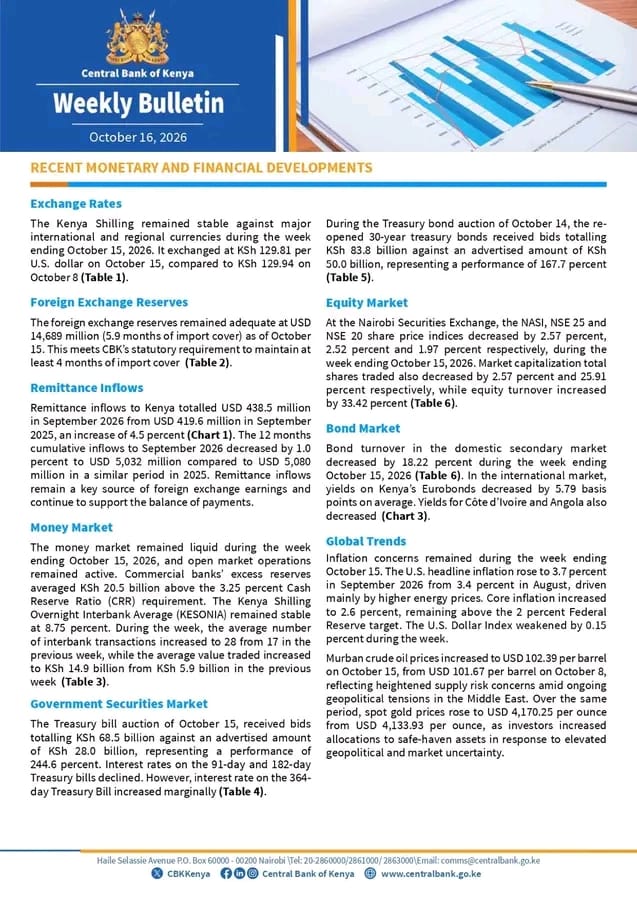
Kenya’s foreign exchange reserves stood at $14.69 billion in the week ending October 15, 2026, providing a buffer against external economic shocks as the Kenyan shilling remained relatively stable against major international and regional currencies.
According to the Central Bank of Kenya’s (CBK) Weekly Bulletin dated October 16, the reserves were sufficient to cover approximately 5.9 months of imports, exceeding the statutory requirement of at least four months of import cover.
The reserves position highlights Kenya’s capacity to meet external payment obligations and support stability in the foreign exchange market amid persistent global economic uncertainty.
The CBK bulletin also reported increased demand for Treasury bonds, rising international oil prices and continued pressure on inflation, reflecting a mixed economic environment for businesses, investors and consumers.
Photo: Central Bank of Kenya
The Kenyan shilling traded at KSh129.81 against the US dollar on October 15, compared with KSh129.94 on October 8, indicating a slight appreciation over the period.
The relatively stable exchange rate provides some predictability for businesses that rely on imported raw materials, machinery, fuel and other goods priced in foreign currencies.
A stable shilling can help importers plan payments and manage operating costs. However, the actual impact on businesses also depends on global commodity prices, transport expenses and the exchange rates offered by commercial banks.
Foreign exchange stability is particularly important for Kenya because the country relies on imports for several essential products, including petroleum and industrial inputs.
The CBK’s foreign exchange reserves provide a cushion against external shocks and help strengthen confidence in the country’s ability to meet international payment obligations.
Kenya’s diaspora remittances increased to $438.5 million in September 2026, up from $419.6 million in August, representing a monthly increase of approximately 4.5 per cent.
The bulletin indicated that cumulative remittance inflows for the 12 months to September 2026 declined by 1.0 per cent to $5.032 billion, compared with $5.080 billion during the corresponding period previously.
Remittances remain an important source of foreign exchange for Kenya, supporting household consumption, education, housing and investment.
The funds also contribute to the country’s foreign currency supply, helping meet demand for dollars from importers and other businesses.
The monthly increase is encouraging for households receiving money from relatives abroad. However, the decline in cumulative inflows suggests that remittance performance remains an area to watch.
Investor appetite for government securities remained strong during the reporting period, with the October 14 Treasury bond auction receiving bids totalling KSh83.8 billion against an advertised amount of KSh50 billion.
This represented a performance rate of 167.7 per cent, indicating that bids substantially exceeded the amount the government had offered.
The strong demand suggests that investors remained willing to commit funds to government debt instruments.
Treasury bonds are used by the government to raise money for public expenditure and refinance existing obligations. They also provide investors with an avenue to earn interest over a specified period.
However, strong demand at an auction does not, by itself, establish that the government’s overall borrowing costs have declined. The final cost depends on the interest rates accepted and the characteristics of the securities issued.
Meanwhile, the CBK reported that the Treasury bill auction on October 15 attracted bids worth KSh68.5 billion against an advertised amount of KSh28 billion, representing a performance rate of 244.6 per cent.
Interest rates on Treasury bills generally declined during the week, although the rate on the 364-day Treasury bill increased marginally.
Trading at the Nairobi Securities Exchange (NSE) weakened during the week ending October 15, according to the CBK bulletin.
Photo: Courtesy
The Nairobi Securities Exchange 20 Share Index declined by 2.57 per cent, while the NASI and NSE 25 indices fell by 2.52 per cent and 1.97 per cent, respectively.
Market capitalisation declined by 2.57 per cent, while total shares traded fell by 2.57 per cent.
Despite the decline in market activity, equity turnover increased by 33.42 per cent, suggesting that the value of shares traded rose even as the total volume of shares exchanged fell.
The mixed performance highlights the importance of examining several indicators when assessing the stock market, rather than relying on a single measure.
For investors, movements in share prices, trading volumes and turnover can provide insights into market sentiment and the level of activity in listed companies.
International oil prices increased during the reporting week, adding to potential cost pressures for oil-importing economies such as Kenya.
The CBK bulletin reported that Murban crude oil rose to $102.39 per barrel on October 15, up from $101.67 on October 8.
Photo : Courtesy
The increase was attributed to supply risks and ongoing geopolitical tensions in the Middle East.
Higher oil prices can affect Kenya through increased import expenditure, higher fuel costs and rising transportation expenses. These pressures may subsequently influence the prices of goods and services.
For businesses, higher fuel prices can raise distribution and production costs, particularly in transport, manufacturing, agriculture and logistics.
If sustained, increases in international oil prices could also place additional pressure on the country’s import bill and inflation outlook.
Gold prices also rose during the week, reaching $4,170.25 per ounce on October 15, compared with $4,133.93 on October 8.
The bulletin attributed the increase to greater demand for safe-haven assets amid heightened geopolitical and market uncertainty.
Kenya’s headline inflation increased to 3.7 per cent in September 2026, up from 3.4 per cent in August, according to the CBK bulletin.
The increase was mainly driven by higher energy prices.
Core inflation also rose to 2.6 per cent, remaining above the US Federal Reserve’s 2 per cent target cited in the bulletin.
Inflation remains a key consideration for policymakers because sustained price increases can reduce household purchasing power and raise operating costs for businesses.
For consumers, higher energy prices can affect transport fares, electricity-related expenses and the cost of goods distributed across the country.
The latest figures suggest that although inflation remains relatively contained, energy costs and global commodity movements continue to pose risks to the domestic price outlook.
The CBK reported that liquidity conditions in the domestic money market remained adequate during the week.
Commercial banks’ excess reserves averaged KSh20.5 billion above the 3.25 per cent Cash Reserve Ratio requirement.
The Kenya Shilling Overnight Interbank Average remained stable at 8.75 per cent.
Meanwhile, the average number of interbank transactions increased to 28 from 17 in the previous week, while the average transaction value rose to KSh14.9 billion from KSh5.9 billion.
These developments point to increased activity in the interbank market, where commercial banks lend to and borrow from one another to manage short-term liquidity needs.
Kenya’s latest financial indicators present a mixed picture.
Foreign exchange reserves remain above the minimum import-cover requirement, the shilling has remained relatively stable, and government securities have attracted substantial investor interest.
However, declining stock market indices, rising international oil prices and a slight increase in inflation underline the challenges facing the economy.
For businesses and investors, the coming weeks will require close monitoring of exchange rates, commodity prices, borrowing costs and domestic demand.
The strength of Kenya’s foreign exchange reserves offers an important buffer, but sustained economic stability will also depend on the country’s ability to manage external shocks, maintain investor confidence and contain inflationary pressures.
As global uncertainty continues to influence financial markets, Kenya’s
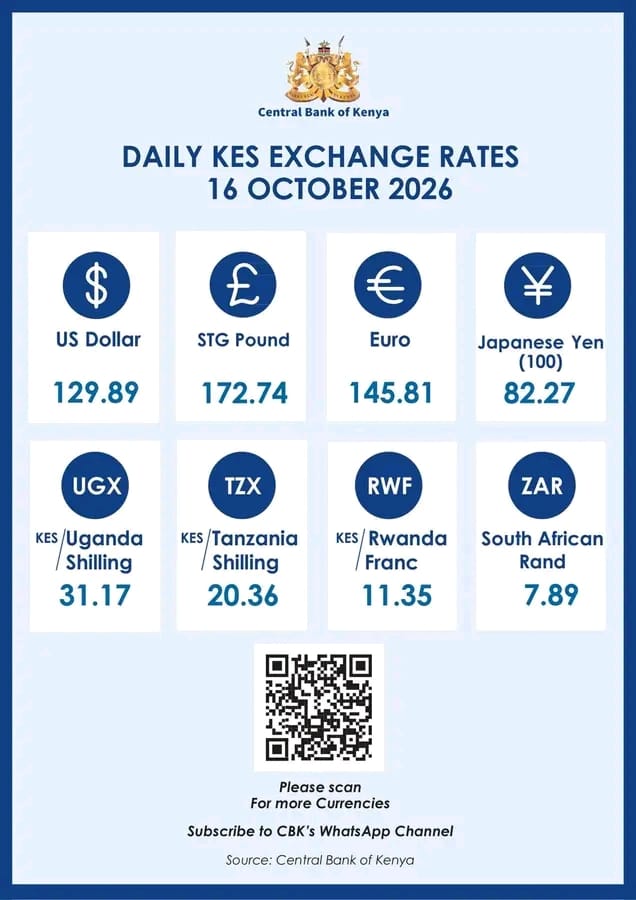
The Central Bank of Kenya (CBK) has published its daily indicative exchange rates for October 16, 2026, placing the US dollar at KSh129.89, the British pound at KSh172.74 and the euro at KSh145.81.
The rates provide a benchmark for businesses, importers, exporters, investors and individuals seeking to understand the value of the Kenyan shilling against major international currencies.
According to the CBK’s daily exchange-rate notice, the Japanese yen, quoted per 100 yen, stood at KSh82.27. Regional currencies were also listed, with the Uganda shilling trading at KSh31.17, the Tanzania shilling at KSh20.36 and the Rwanda franc at KSh11.35 against the Kenyan shilling. The South African rand was quoted at KSh7.89.
The publication comes as foreign-exchange movements remain an important consideration for businesses involved in international trade, particularly those importing fuel, machinery, electronics, pharmaceutical products and other goods priced in foreign currencies.
The US dollar rate is particularly important for Kenyan businesses because many international commodities and imports are priced in dollars.
At the indicative rate of KSh129.89 per dollar, an importer purchasing goods worth US$10,000 would require approximately KSh1,298,900 to cover the dollar amount, excluding bank charges, transaction fees, shipping costs, taxes and other expenses.
Changes in exchange rates can influence the cost of importing goods and, in some cases, the prices eventually paid by consumers.
A weaker shilling generally makes foreign-currency purchases more expensive in local-currency terms, while a stronger shilling can reduce the cost of imports, assuming other factors remain unchanged.
However, the actual rate available to an importer will depend on the commercial bank or foreign-exchange provider handling the transaction.
The British pound was quoted at KSh172.74, while the euro stood at KSh145.81.
Photo: Central Bank of Kenya
These rates are relevant to Kenyans paying tuition fees abroad, travelling internationally, receiving remittances or conducting business with partners in the United Kingdom and the euro area.
Businesses importing products from European markets may also use the published rates as a reference when estimating their foreign-currency obligations.
For exporters and recipients of foreign-currency payments, exchange-rate movements can affect the amount of Kenyan shillings received when overseas earnings are converted into local currency.
The CBK’s exchange-rate notice also listed currencies used by Kenya’s regional trading partners.
The Uganda shilling stood at KSh31.17, the Tanzania shilling at KSh20.36 and the Rwanda franc at KSh11.35.
These indicative rates provide a reference for businesses conducting cross-border trade within East Africa, including companies involved in agricultural products, manufactured goods, transport and wholesale distribution.
However, businesses should confirm the applicable transaction rates with their financial institutions before making payments or entering into foreign-exchange agreements.
The Central Bank of Kenya explains that its published exchange rates are calculated using the weighted average of registered spot transactions in the interbank foreign-exchange market.
The rates are intended to help the public gauge the value of the shilling. The CBK does not directly set the exchange rate, which is determined by market supply and demand.
Commercial banks and foreign-exchange bureaus may offer different buying and selling rates because of their operating costs, transaction sizes and margins.
Consequently, the published figures should be treated as indicative reference rates rather than guaranteed prices for individual transactions.
Businesses dealing in foreign currencies should continue monitoring exchange rates when preparing import budgets, pricing products and planning international payments.
Importers may need to account for possible currency movements when negotiating supplier contracts, while exporters should consider how changes in the shilling affect the local-currency value of their overseas earnings.
Individuals sending money abroad or receiving foreign remittances should also compare the rates and charges offered by different financial-service providers.
The latest CBK notice offers a daily reference point for these decisions, although determining whether the shilling has strengthened or weakened requires comparing the figures with previous rates.
As Kenya continues to engage in international and regional trade, foreign-exchange rates remain a key consideration for business costs, household transactions and financial planning.
Kenya’s economy grew by 5.1 per cent in the second quarter of 2026, up from 4.9 per cent during the same period last year, signalling continued economic expansion despite persistent cost pressures facing businesses and households.
According to a report published by Reuters on Friday, the latest growth was supported by improvements in several sectors, including transportation and storage, accommodation and food services, information and communication technology (ICT), financial services, electricity and construction.
The figures point to continued activity across key parts of the economy, with implications for businesses, investors and policymakers as Kenya seeks to sustain growth while managing the cost of doing business.
The transportation and storage sector recorded growth of 4.4 per cent in the second quarter of 2026, compared with 3.3 per cent during the corresponding period in 2025.
Photo: Courtesy
The improvement highlights the importance of transport and logistics in supporting economic activity, particularly in a country where businesses depend on road networks, ports and distribution systems to move agricultural produce, manufactured goods and imported products.
Growth in accommodation and food services also contributed to the economy’s performance, reflecting the role of hospitality and related services in generating business activity.
Meanwhile, ICT and financial services continued to contribute to economic expansion, underlining the growing importance of technology and financial intermediation in supporting businesses and consumers. RReuters
Construction and electricity were among the other sectors supporting Kenya’s economic performance during the quarter.
Construction activity is important for employment, infrastructure development and demand for materials such as cement, steel and other building supplies. Expansion in the sector can also create opportunities for transport companies, suppliers and small businesses serving construction projects.
The electricity sector similarly plays a central role in economic activity because energy costs influence production expenses, operating costs and investment decisions across industries.
However, the latest growth figures alone do not establish whether individual businesses have experienced higher profits or whether the benefits of economic expansion have been distributed evenly across households.
Photo: Courtesy
Despite the improvement in economic growth, businesses continue to operate in an environment shaped by financing costs, energy prices, exchange-rate movements and consumer purchasing power.
Higher operating costs can limit the ability of small and medium-sized enterprises to expand, hire additional workers or invest in new equipment.
Transport operators, manufacturers, retailers and food businesses are particularly sensitive to changes in fuel prices because these costs can affect distribution expenses and the final prices paid by consumers.
For households, the relationship between economic growth and living standards will depend partly on whether the expansion translates into additional employment, stronger incomes and more affordable goods and services.
The latest figures provide investors with an indication of the sectors contributing to Kenya’s economic expansion.
Transport and logistics businesses may benefit from increased commercial activity, while construction companies and suppliers could find opportunities as infrastructure and building activity develops.
ICT and financial services also remain important areas to watch as businesses increasingly rely on digital platforms, electronic payments and technology-based services.
However, investors will need to consider company-specific financial results, market conditions and operating costs rather than relying on national economic growth figures alone.
Kenya’s second-quarter growth rate of 5.1 per cent represents an improvement on the 4.9 per cent recorded in the same period in 2025.
Sustaining that momentum will depend on the performance of productive sectors, the cost of credit, domestic demand, infrastructure investment and broader economic conditions.
Policymakers will also need to consider whether growth is generating sufficient employment and improving the financial position of households and businesses.
For companies planning expansion, the latest figures provide a positive indication of economic activity, although individual sectors may continue to face different challenges.
Kenya has confirmed a third case of Ebola virus disease after a 65-year-old woman tested positive while in quarantine, prompting health authorities to intensify contact tracing and surveillance to prevent further spread of the virus.
The Ministry of Health said the woman, a close relative of the first two confirmed patients, developed fever, a sore throat and general weakness before laboratory tests confirmed the infection. She had been in quarantine since October 6 and was transferred to an infectious disease unit, where she is receiving supportive medical care.
Photo: Courtesy
Health officials said the early detection of the infection was important in reducing the risk of further transmission. The second patient, a 39-year-old man from the same family, was reported to be in stable condition.
The three cases are linked to Kenya’s first confirmed patient, a 40-year-old man who had been living in the Democratic Republic of the Congo (DRC) before travelling to Kenya. He arrived in Nairobi on October 3 after travelling through Uganda and died in hospital on October 5.
According to the Ministry of Health, there was no evidence of wider community transmission as of Friday, although investigations and monitoring of exposed individuals were continuing.
Authorities have identified 130 people who may have come into contact with the first patient. By October 16, 127 had been traced, while efforts to locate the remaining three were ongoing.
The identified contacts were placed under quarantine and monitoring to help detect possible infections before they spread to others.
Health officials have also strengthened screening at major points of entry, including Jomo Kenyatta International Airport in Nairobi and the Busia border crossing with Uganda.
The measures include temperature checks, health assessments and improved surveillance of travellers arriving from countries considered at higher risk of Ebola transmission.
The latest case has renewed attention on the challenges of preventing infectious diseases from crossing international borders, particularly when travellers move through several countries before an infection is identified.
Kenya’s cases are linked to an ongoing outbreak of Bundibugyo virus disease in the Democratic Republic of the Congo.
The outbreak has become one of the most serious Ebola epidemics recorded globally, with more than 9,000 confirmed cases and over 4,000 deaths reported in the DRC by mid-October, according to Reuters.
The Bundibugyo strain is a rare species of Ebola virus. Unlike some other Ebola strains, it currently has no approved vaccine or specific treatment, making early diagnosis, isolation and supportive medical care particularly important.
Ebola spreads primarily through direct contact with the blood or other bodily fluids of an infected person who is showing symptoms, or through contaminated materials. It does not spread simply because people live in the same community.
Symptoms can include fever, severe fatigue, headache, muscle pain, vomiting and diarrhoea. Some patients may develop bleeding in severe cases.
The Ministry of Health has urged Kenyans to remain alert without panicking, stressing the importance of following official public health guidance.
Members of the public have been advised to practise good hand hygiene, avoid contact with bodily fluids from suspected or confirmed cases and seek medical attention promptly if they develop symptoms after a possible exposure.
Healthcare workers have also been urged to maintain infection prevention and control measures when assessing patients with compatible symptoms and relevant travel or exposure histories.
The World Health Organization is supporting efforts to strengthen surveillance, laboratory testing and infection control as Kenya works to contain the infections.
Although the three confirmed cases have been linked to the first patient, health authorities continue to monitor exposed individuals because additional infections may emerge among people already in quarantine.
The government’s immediate priority is to trace all remaining contacts, ensure that patients receive appropriate care and prevent further transmission into the wider community.
As investigations continue, officials say public cooperation and timely reporting of suspected infections will remain essential to containing the threat.
World leaders meeting at the international climate summit concluded talks this week with a new agreement setting ambitious renewable energy targets for the coming decade.
Delegates from more than 190 countries committed to accelerating the transition away from fossil fuels and increasing investment in clean energy infrastructure. The final text includes specific goals for solar, wind, and energy-storage capacity by 2035.
Negotiators described the deal as a significant step forward after difficult discussions on financing for developing nations. Wealthier countries pledged additional support for technology transfer and adaptation projects in vulnerable regions. Environmental groups welcomed the clearer timelines but urged faster implementation to meet existing temperature goals.
The agreement also establishes a framework for monitoring progress and sharing best practices among participating nations. Several major economies announced updated national plans aligned with the new targets during the closing sessions. Analysts noted that the consensus reflects growing recognition of the economic opportunities linked to the clean-energy transition.
Follow-up meetings are scheduled for next year to review early progress and address remaining gaps in climate finance. Officials said the outcome demonstrates that multilateral cooperation remains possible on one of the most pressing global challenges.
Thousands of residents and visitors gathered in Mombasa this week for the annual coastal cultural festival, which showcased traditional music, dance, and cuisine from the Swahili coast.
Organizers said attendance was higher than in previous years, with performances drawing crowds from as far as Lamu and Malindi. The event featured storytelling sessions, boat processions, and exhibitions of local handicrafts.
Artists and cultural groups from different communities along the coast presented dances and songs that highlight shared heritage while celebrating regional diversity. Food stalls offered classic dishes prepared using traditional methods, attracting both locals and tourists.
Festival organizers partnered with the county government to ensure the event remained accessible and family-friendly. Young performers were given dedicated stages to showcase contemporary interpretations of coastal arts, helping to pass traditions to the next generation.
Tourism officials noted that the festival continues to boost visitor numbers during the shoulder season. Security and sanitation arrangements were praised by attendees for keeping the multi-day event orderly.
Plans are already underway to expand next year’s edition with additional workshops and international cultural exchanges. Community elders said the gathering reinforces pride in coastal identity and strengthens social ties across the region.
A newly completed section of the Kisumu–Busia highway has significantly reduced travel time for traders and residents in western Kenya.
The 45-kilometre stretch, upgraded under a national infrastructure program, features dual carriageways, improved drainage, and street lighting in key market towns. Local business owners said the smoother road surface has already lowered vehicle maintenance costs and improved the delivery of perishable goods.
County officials in both Kisumu and Busia noted a sharp drop in reported accidents along the route since the upgrade was opened to traffic last month. Pedestrian walkways and designated bus bays were included in the design to enhance safety for daily commuters. Farmers transporting produce to regional markets reported that journey times have been cut by nearly an hour in some cases. The project also created temporary employment for hundreds of local workers during construction.
Community leaders praised the inclusion of roadside amenities such as rest stops and emergency service points. Engineers confirmed that the road was built to withstand heavy rains common in the region.
Further sections of the corridor are scheduled for upgrading in the coming financial year. Residents expressed hope that the improved connectivity will attract more investment and support growth in agriculture and small-scale trade across the border counties.
Primary and secondary schools in several informal settlements across Nairobi have started rolling out a new digital learning initiative aimed at bridging the technology gap.
The program, supported by the Ministry of Education and private partners, has already distributed tablets and solar-powered charging stations to more than 40 schools in areas including Kibera, Mathare, and Mukuru. Teachers received specialized training to integrate the devices into daily lessons. Students are now able to access interactive lessons in mathematics, science, and English even during power outages, thanks to the solar units.
School heads reported improved attendance and engagement in the first month of implementation. Parents in the targeted communities welcomed the move, saying it gives their children a fairer chance to compete with peers in better-resourced schools.
Education officials emphasized that the tablets come pre-loaded with the national curriculum and offline content to avoid heavy data costs.
Monitoring teams will visit participating schools every term to assess progress and address technical challenges. Early feedback from teachers indicates that learners who previously struggled with textbooks are responding positively to the visual and interactive materials.
The county education board plans to expand the program to additional schools in the next academic year if the pilot continues to show strong results. Stakeholders stressed that sustained teacher support and device maintenance will be critical to long-term success.